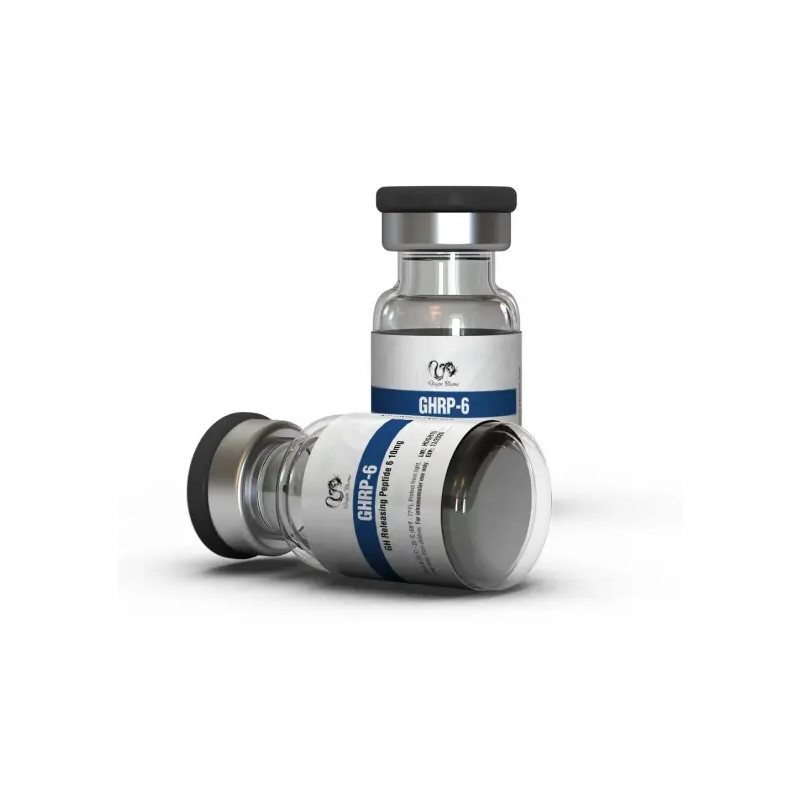
GHRP-6 — The Original GHRP with Strongest Appetite Stimulation by Dragon Pharma
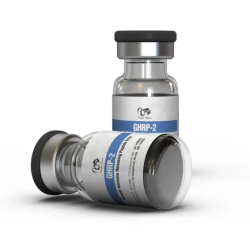
GHRP-6 (Growth Hormone Releasing Peptide-6) is Dragon Pharma's formulation of the first synthetic GHRP at 10mg per vial — the original GHS-R1a agonist developed by Bowers et al. beginning in the early 1980s, predating the discovery of its endogenous ligand ghrelin by nearly two decades. GHRP-6 occupies a distinct position in the GHRP hierarchy: moderate-to-high GH stimulation combined with the most pronounced appetite stimulation of any GHRP — a profile that makes it specifically valuable for mass-building phases where hitting caloric targets is as important as GH elevation.
Also searched as: GHRP-6 10mg, GHRP 6 peptide, GHRP-6 appetite, GHRP-6 Dragon Pharma, growth hormone releasing peptide 6.
GHRP-6's Historical Significance — The First Synthetic Ghrelin Receptor Agonist
Understanding GHRP-6 requires appreciating its role in the history of GH research:
- Cyril Bowers and colleagues at Tulane University first synthesised compounds capable of stimulating GH release independently of GHRH in the early 1980s — the compound that became GHRP-6 was among the first characterised synthetic GHRPs, published in research through 1984
- At the time of GHRP-6's development, the receptor it activated was unknown — it was simply observed to stimulate GH through a novel pathway. It wasn't until 1996 that Howard et al. cloned the GHS-R1a receptor, and not until 1999 that Kojima et al. identified ghrelin as the endogenous ligand for this receptor
- In other words: GHRP-6 was developed and studied for 15+ years before anyone knew what receptor it activated or that an endogenous hormone (ghrelin) existed for that receptor. GHRP-6 was effectively a pharmacological probe that revealed the existence of an entire hormonal axis
- This historical context also explains GHRP-6's larger 10mg vial vs GHRP-2's 5mg — GHRP-6 is typically used at higher volumes per cycle due to its appetite-stimulating bulk-focused application
Why GHRP-6 Has the Strongest Appetite Effect
The appetite mechanism is GHRP-6's defining characteristic and is rarely explained accurately:
- GHS-R1a is expressed throughout the body but the density and coupling efficiency varies significantly by tissue. In the gut and vagal afferent neurons — the primary pathway for hunger signalling from gut to brain — GHRP-6 has particularly strong activity compared to other GHRPs
- Ghrelin (the endogenous GHS-R1a agonist) rises before meals and signals hunger. GHRP-6 more closely mimics ghrelin's peripheral gut activity than GHRP-2, Hexarelin or Ipamorelin — producing a more intense and longer-lasting hunger signal
- The practical consequence: GHRP-6 injections frequently produce a compelling, sometimes overwhelming hunger within 20-30 minutes — users often plan injections to coincide with meal timing so the appetite peak aligns with eating
- This appetite stimulation is simultaneously GHRP-6's primary advantage for mass building (assists with caloric surplus maintenance) and its limiting factor for cutting (pronounced hunger during caloric deficit can be counterproductive)
GHRP-6 in the Complete GHRP Comparison
| Parameter |
GHRP-6 |
GHRP-2 |
Hexarelin |
Ipamorelin |
| Year developed |
Early 1980s (first GHRP) |
Later generation |
Later generation |
Latest generation |
| GH potency |
Moderate-High |
High |
Highest |
Moderate |
| Appetite stimulation |
Strongest of all GHRPs |
Mild-Moderate |
Mild |
None |
| Cortisol elevation |
Moderate |
Moderate |
Significant |
Minimal |
| Best application |
Mass building — appetite + GH |
Balanced GH with mild appetite |
Maximum GH short cycles |
Clean long-term GH |
| Clinical use |
Cancer cachexia research |
Japan diagnostic test |
Cardiac research |
Clinical trials ongoing |
| Vial size (Dragon Pharma) |
10 mg |
5 mg |
5 mg |
Various |
GHRP-6 in Clinical Research — Cancer Cachexia
GHRP-6's clinical research history beyond the GH stimulation studies:
- Cancer cachexia (the profound weight loss and muscle wasting associated with advanced cancer) has been an area of GHRP-6 investigation specifically because of its combined GH-elevating and appetite-stimulating properties — addressing two of the primary cachexia drivers simultaneously
- Multiple Phase I and II studies have investigated GHRP-6 for cachexia — the appetite stimulation that is a side effect in healthy users is a therapeutic objective in this context
- This clinical research generated human safety and pharmacokinetic data relevant to performance users — confirming tolerability at doses above typical performance protocols
Effects and Benefits
- Moderate-to-high GH pulse stimulation via GHS-R1a — meaningful GH elevation for anabolic and recovery effects
- Strongest appetite stimulation of any GHRP — the primary differentiating feature; beneficial for mass phases
- Combined GH + appetite effect for mass building — two mechanisms supporting caloric surplus simultaneously
- Synergistic with GHRH analogues — 3-5× GH amplification with CJC-1295 or Tesamorelin
- Historical clinical data from cachexia research — human safety profile beyond animal studies
- No testosterone suppression — no PCT required
Dosage and Administration
| Protocol |
Dose |
Timing |
Frequency |
| Mass building |
100–300 mcg |
Before meals — appetite peak coincides with eating |
2–3× daily |
| GH optimisation |
100–200 mcg |
Fasted or pre-workout; before bed |
2–3× daily |
At 10mg per vial and 200mcg per injection dosed 2× daily, one vial provides 25 days of dosing. The larger 10mg vial versus GHRP-2's 5mg reflects GHRP-6's typical use at higher cumulative volume in mass-phase protocols. A practical GHRP-6 timing approach for mass building: inject 15-20 minutes before a planned large meal — the appetite peak arrives as food is available, making it much easier to consume a large meal. Reconstitute with bacteriostatic water. Store refrigerated at 2-8°C after reconstitution.


 Security policy
 Delivery policy
 Return policy