- On sale!
- -11%

 Security policy
(edit with the Customer Reassurance module)
 Delivery policy
(edit with the Customer Reassurance module)
 Return policy
(edit with the Customer Reassurance module)
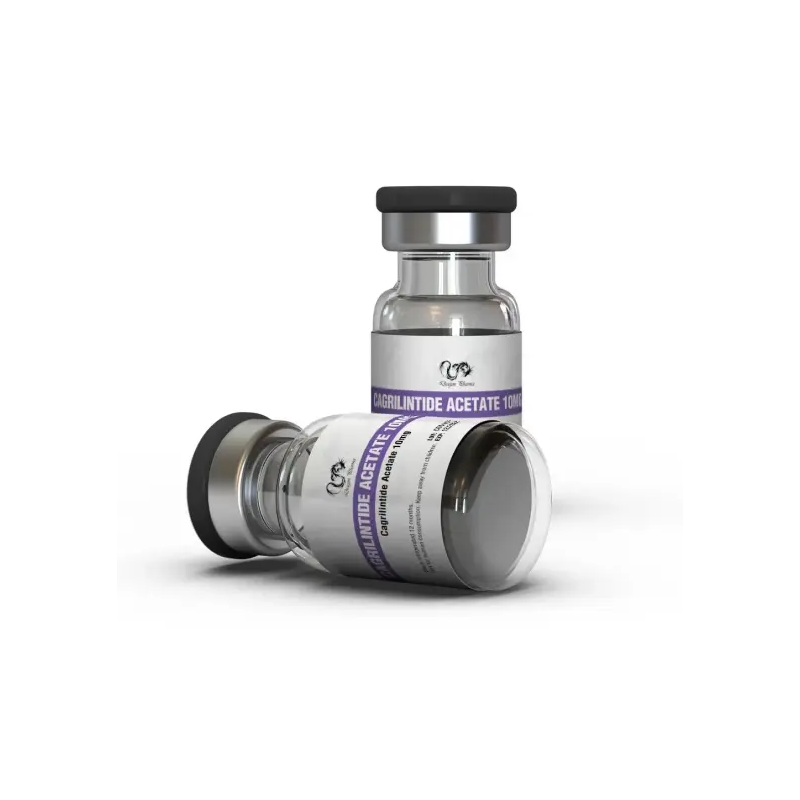
Cagrilintide is Dragon Pharma's formulation of the long-acting amylin analogue Cagrilintide at 10mg per vial — a novel once-weekly peptide developed by Novo Nordisk targeting amylin receptors (AMY1-3) for appetite suppression and body weight reduction through a mechanism entirely distinct from GLP-1 agonists. With an approximately 7-8 day half-life, a single vial covers multiple weekly doses.
Also searched as: Cagrilintide 10mg, amylin analogue peptide, CagriSema component, Cagrilintide Dragon Pharma.
Amylin is a 37 amino acid peptide hormone co-secreted with insulin from pancreatic beta cells in response to meals. Unlike GLP-1 (which acts primarily on the hypothalamus and brainstem via the vagus nerve), amylin acts directly on the area postrema — a circumventricular organ in the brainstem that lacks a blood-brain barrier, making it uniquely accessible to circulating peptides:
Native amylin has a very short half-life (~10-15 minutes) — too short for practical therapeutic use. Cagrilintide addresses this through several structural modifications:
Cagrilintide's most important clinical evidence comes from its combination with Semaglutide (GLP-1 agonist) in Novo Nordisk's CagriSema Phase III programme — data that most competitor content has not adequately covered:
| Trial | Combination | Weight Loss Result | Duration |
|---|---|---|---|
| REDEFINE 1 (Phase III, 2024) | Cagrilintide 2.4mg + Semaglutide 2.4mg weekly | ~22.7% mean body weight reduction | 68 weeks |
| Phase II dose-finding | Cagrilintide 2.4mg + Semaglutide 2.4mg | ~15.6% body weight reduction | 32 weeks |
| Cagrilintide monotherapy (Phase II) | Cagrilintide 2.4mg alone | ~10.8% body weight reduction | 26 weeks |
| Tirzepatide (for comparison) | Tirzepatide 15mg alone | ~20.9% body weight reduction | 72 weeks |
The REDEFINE 1 data positions the CagriSema combination as a direct competitor to Tirzepatide — achieving approximately 22.7% body weight reduction at 68 weeks versus Tirzepatide's 20.9% at 72 weeks. This combination approach (amylin + GLP-1) represents the emerging frontier of peptide-based weight management beyond single-mechanism approaches.
| Protocol | Weight Loss Potential | Mechanism Coverage | Practical Notes |
|---|---|---|---|
| Cagrilintide alone | ~10-11% over 26 weeks | Amylin pathway only | Modest standalone; most practical as part of combination |
| Cagrilintide + Tirzepatide | Theoretically highest — triple mechanism | Amylin + GLP-1 + GIP | Not yet in Phase III; triple mechanism hypothesis |
| Cagrilintide + Semaglutide (CagriSema) | ~22.7% over 68 weeks (Phase III) | Amylin + GLP-1 | Most clinically validated combination; REDEFINE 1 data |
| Phase | Dose | Frequency | Notes |
|---|---|---|---|
| Starting dose | 0.3–0.6 mg | Once weekly | Allow 4 weeks before escalation |
| Titration | 1.2–2.4 mg | Once weekly | Titrate every 4 weeks based on tolerance |
| Maintenance | 2.4 mg | Once weekly | Clinical trial dose — 10mg vial covers ~4 doses |
At 10mg per vial and 2.4mg per weekly dose, one vial provides approximately 4 weeks of dosing at maintenance. Reconstitute with bacteriostatic water before use. Unlike peptides requiring fasted dosing, Cagrilintide's mechanism is not significantly affected by meal timing — once-weekly injection can be taken at any time.