- -11%
- New

 Security policy
(edit with the Customer Reassurance module)
 Delivery policy
(edit with the Customer Reassurance module)
 Return policy
(edit with the Customer Reassurance module)
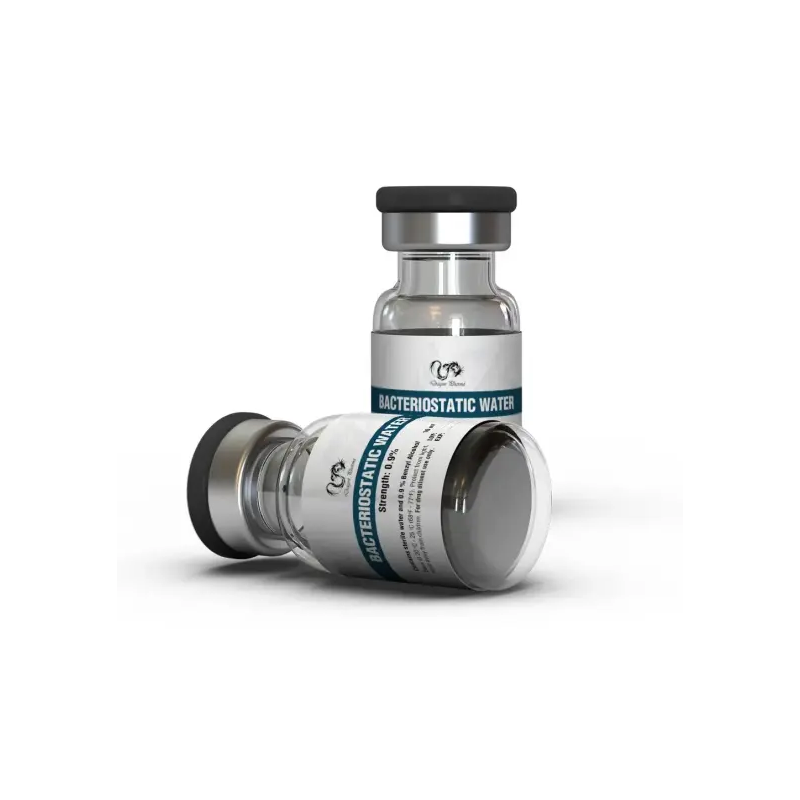
Dragon Pharma Bacteriostatic Water is sterile water for injection containing 0.9% benzyl alcohol (BnOH) as a preservative — the standard pharmaceutical diluent for reconstituting lyophilised peptides and hormones. It is the correct and only appropriate diluent for all Dragon Pharma peptide vials, including HGH, BPC-157, TB-500, Ipamorelin, CJC-1295, Tesamorelin and all other lyophilised products in the range.
Also searched as: Bacteriostatic water 0.9%, BnOH water peptides, sterile diluent peptide reconstitution, bacteriostatic water Dragon Pharma.
The distinction between bacteriostatic water and plain sterile water is clinically important and consistently misunderstood — a genuine information gap in competitor content:
| Property | Bacteriostatic Water (0.9% BnOH) | Plain Sterile Water for Injection |
|---|---|---|
| Preservative | 0.9% benzyl alcohol — inhibits bacterial growth | None |
| Multi-dose use | Yes — vial can be entered multiple times safely | No — single use only; contamination risk after first draw |
| Reconstituted vial shelf life | Up to 28 days refrigerated | 24 hours maximum — contamination risk increases rapidly |
| Appropriate for peptide reconstitution | Yes — the standard choice | Only acceptable for single-use immediately after reconstitution |
| Cost of error | — | Contaminated vial = wasted peptide; potential injection site infection |
The practical consequence: peptides reconstituted with plain sterile water must be used within 24 hours of reconstitution and the entire vial consumed in a single use — making it impractical for daily-dosed peptides like Ipamorelin or BPC-157 where the vial is accessed multiple times over weeks. Bacteriostatic water's 0.9% benzyl alcohol prevents bacterial proliferation between draws, making safe multi-dose use possible over up to 28 days.
Benzyl alcohol in bacteriostatic water is frequently described as a "preservative" without explanation of how it works — this is an important information gap:
| Step | Action | Why |
|---|---|---|
| 1 | Wipe both vial tops (peptide and bacteriostatic water) with an alcohol swab | Removes surface contamination before needle entry |
| 2 | Draw the required volume of bacteriostatic water into the syringe | Volume determines final concentration per unit — calculate before drawing |
| 3 | Insert needle into the peptide vial and inject the water slowly along the vial wall — not directly onto the lyophilised powder | Direct stream can damage fragile protein structure; gentle wall injection preserves peptide integrity |
| 4 | Swirl gently to dissolve — do not shake | Shaking creates air bubbles and can denature peptide proteins through mechanical stress |
| 5 | Allow to fully dissolve (1–2 minutes) before drawing | Ensures even concentration throughout the vial |
| 6 | Store reconstituted vial refrigerated at 2-8°C | Maintains peptide stability; never freeze a reconstituted vial |
The volume of bacteriostatic water used determines the concentration per unit drawn. For a 5mg peptide vial dosed at 200mcg per injection:
There is no single "correct" reconstitution volume — it is chosen based on desired dose per injection, syringe type, and personal preference for injection volume. The key is calculating dose per unit before drawing and remaining consistent across all draws from the same vial.