- -11%
- New

 Security policy
(edit with the Customer Reassurance module)
 Delivery policy
(edit with the Customer Reassurance module)
 Return policy
(edit with the Customer Reassurance module)
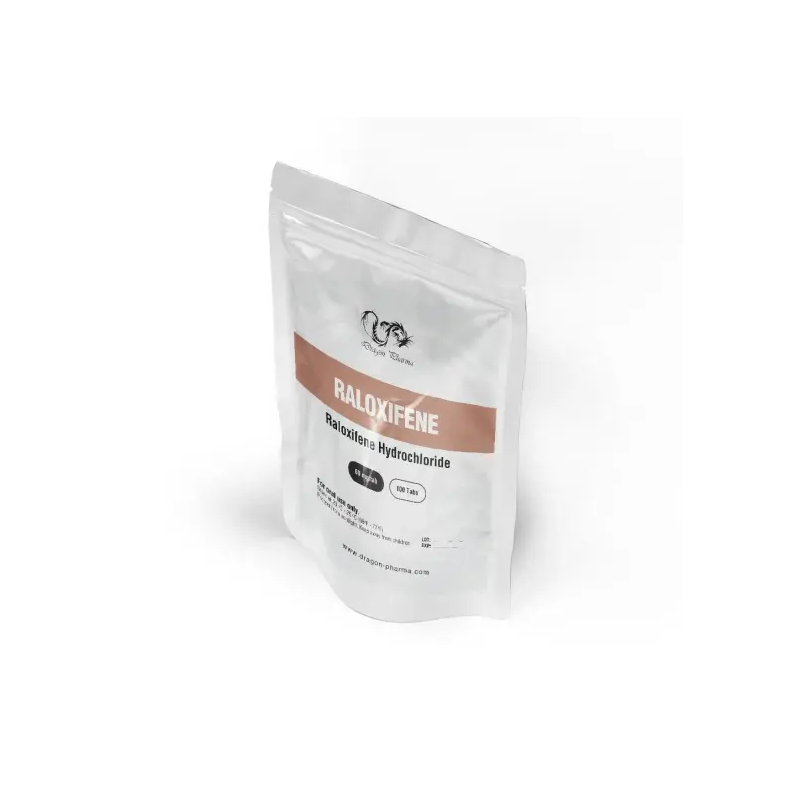
Raloxifene is Dragon Pharma's formulation of Raloxifene Hydrochloride at 60mg per tablet — a third-generation selective estrogen receptor modulator (SERM) FDA-approved for osteoporosis treatment and breast cancer risk reduction, and increasingly used in bodybuilding specifically for the treatment of existing gynecomastia where Tamoxifen (Nolvadex) has shown inferior results in direct comparative studies.
Also searched as: Raloxifene 60mg, Evista tabs, Raloxifene gynecomastia, Raloxifene Dragon Pharma.
SERMs are classified by generation based on their tissue selectivity and clinical development timeline:
The generational advance is clinically significant: Raloxifene's improved receptor binding profile and tissue selectivity translate to a different pattern of agonist/antagonist effects across tissues, which explains both its superior efficacy for existing gynecomastia and its different (generally less favourable) profile for testosterone recovery vs Tamoxifen.
This is the most important and most poorly-explained distinction in all competitor content on these two SERMs:
| Parameter | Raloxifene (60mg) | Nolvadex (Tamoxifen) | Clomid (Clomiphene) |
|---|---|---|---|
| Gynecomastia treatment | Superior — 86% reduction in trials | Moderate — 41% reduction in same trials | Not indicated |
| Gynecomastia prevention | Effective | Standard choice | Some effect via estrogen receptor |
| LH/FSH stimulation for PCT | Minimal — weak hypothalamic activity | Moderate — some pituitary LH stimulation | Strong — primary PCT SERM |
| Breast tissue ER antagonism | Strongest — pure antagonist | Moderate — partial agonist activity present | Mixed — not breast-tissue specific |
| Bone density | Positive — agonist in bone (FDA approved for osteoporosis) | Neutral in men | Neutral |
| Visual side effects | Rare | Possible | Common — Zuclomiphene component |
| Half-life | ~27 hours | ~5–7 days | Mixed: ~10h + ~30 days |
The clinical evidence points to specific use cases for each:
| Use Case | Dose | Duration |
|---|---|---|
| Existing gynecomastia treatment | 60 mg/day (1 tab) | 3–6 months for established tissue |
| On-cycle gynecomastia prevention | 60 mg/day | Duration of cycle |
| Combined with PCT SERMs | 60 mg/day Raloxifene + Clomid/Nolvadex | Duration of PCT |
Raloxifene's ~27-hour half-life makes once-daily dosing straightforward. The 60mg tablet is the standard dose used in all major clinical trials — no splitting required. Duration for treating established gynecomastia is longer than for prevention — studies ran 3-9 months to achieve the documented 86% breast tissue reduction.